
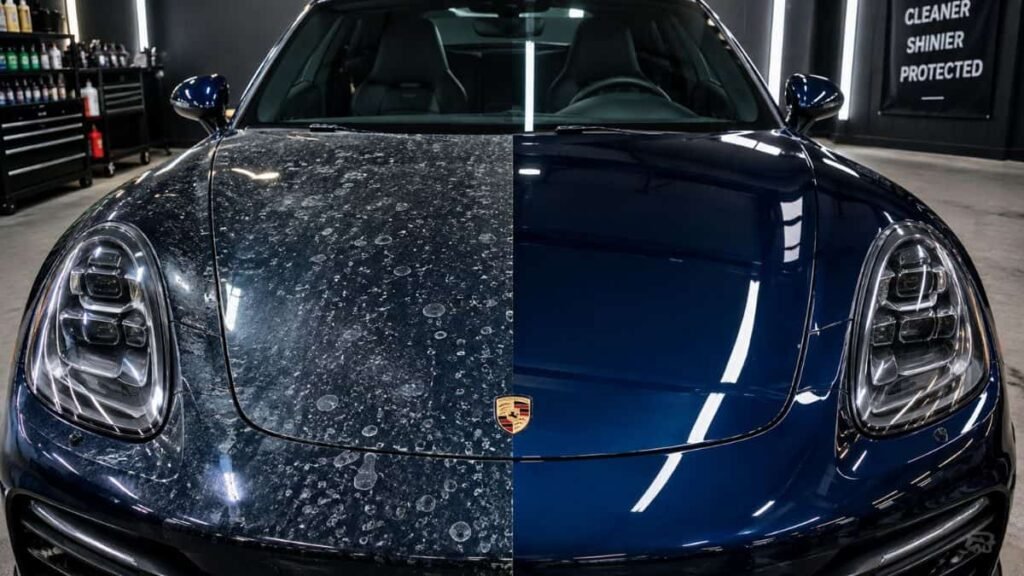
Few things ruin the look of a freshly washed vehicle faster than stubborn, cloudy mineral stains left drying on the paint and windows. If you want to know how to remove water spots from car surfaces effectively, you are not alone. Whether caused by a stray lawn sprinkler, hard tap water, or rain mixed with atmospheric pollution, these marks require specific treatments. Knowing how to remove water spots from car clear coats quickly prevents permanent etching and expensive paint correction down the road.
Understanding how to remove water spots from car panels safely is an essential skill for every vehicle owner. Just as you need to address sudden dashboard warnings by following our guide on fixing the VSA light issue, taking quick action on exterior paint defects saves you time and money. This guide breaks down the science behind mineral spotting, identifies the exact type of marks ruining your finish, and provides a step-by-step roadmap on how to remove water spots from car finishes.
Quick Summary: Choosing the Right Removal Method
| Method | Target Damage Level | Key Tools Required | Risk to Paint |
| Contact Wash & Detail Spray | Fresh surface dust & mineral residue | Car shampoo, microfiber towels | Very Low |
| Diluted White Vinegar | Light, unbonded hard water rings | White vinegar, distilled water | Low (Strips Wax) |
| Detailing Clay Bar | Textured, bonded mineral buildup | Clay bar, synthetic lubricant | Low |
| Chemical Water Spot Remover | Stubborn, baked-on mineral spots | Dedicated gel/spray remover | Moderate |
| Machine Polishing | Etched rings & deep “crater” marks | Dual-action polisher, polish | Moderate-High |
What Causes Water Spots on Cars?
Water spots occur when a droplet of water sits on a vehicle panel and evaporates, leaving behind concentrated solids that were suspended within it. Before learning how to remove water spots from car bodywork, it helps to understand where they come from. Ground water from garden hoses and sprinklers is typically loaded with dissolved minerals like calcium, magnesium, and sodium.
Rainwater, while naturally softer, absorbs industrial fallout, exhaust soot, and airborne dirt as it falls. When a droplet heats up under direct sunlight, the water evaporates first, trapping high concentrations of minerals and acids directly against your clear coat or glass. Finding out how to remove water spots from car surfaces early keeps these minerals from baking permanently into your finish.
The 4 Primary Types of Water Spots Explained
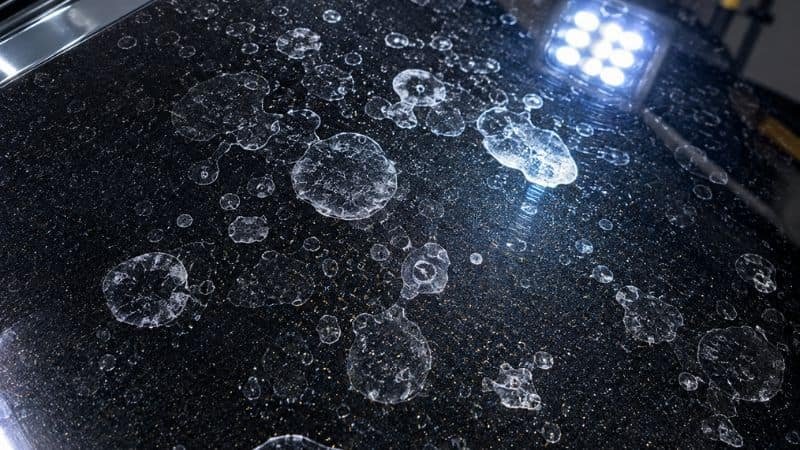
Before deciding how to remove water spots from car panels, you must diagnose the severity of the damage. Detailers categorize mineral marks into four primary levels:
1. Type 1: Surface Mineral Deposits
These are basic, fresh hard water spots. They look like crusty white rings sitting directly on top of the paint. Learning how to remove water spots from car finishes at this stage is easy because the minerals haven’t bonded yet.
2. Type 2: Bonded Mineral Contamination
When mineral deposits sit under high temperatures, they form a tough chemical bond with the clear coat. Standard washing won’t work, so discovering how to remove water spots from car clear coats with chemical solutions becomes necessary.
3. Type 3: Imprint Ring Etchings
If corrosive water sits on a panel repeatedly, the acidic elements eat away at the outer edge of the water droplet. Thousands of car owners report severe chemical etching on automotive forums like CarComplaints when hard water sits unaddressed under heat. Knowing how to remove water spots from car finishes with physical polish is required here, as the ring sits inside the clear coat.
4. Type 4: Deep “Crater” Etchings
The most severe form of water spot damage. Highly acidic or alkaline water eats deep into the clear coat, dissolving the physical paint layer. Knowing how to remove water spots from car panels at this level requires heavy compounding.
Step-by-Step Guide: How to Remove Water Spots from Car Surfaces
To protect your vehicle’s clear coat, always start with the least aggressive method first when testing how to remove water spots from car panels.
[Level 1: Contact Wash] ➔ [Level 2: Vinegar Solution] ➔ [Level 3: Clay Bar] ➔ [Level 4: Chemical Remover] ➔ [Level 5: Machine Polish]
Method 1: The Contact Wash & Detail Spray (For Fresh Spots)
If you are wondering how to remove water spots from car paint right after exposure, a standard wash is often enough.
- Step 1: Park the vehicle in a shaded area and ensure the body panels are cool to the touch.
- Step 2: Wash the vehicle using a quality, pH-balanced car shampoo and a soft microfiber wash mitt.
- Step 3: Rinse thoroughly with free-flowing water.
- Step 4: Dry immediately using a thick, waffle-weave or twist-loop microfiber drying towel.
- Step 5: Spray a high-lubricity quick detailer on any remaining light rings. Knowing how to remove water spots from car panels with quick detailer saves time during weekly maintenance.
Method 2: The Diluted White Vinegar Flush (Best DIY Home Remedy)
Distilled white vinegar contains acetic acid, which naturally neutralizes basic mineral deposits like calcium and magnesium. This is a popular DIY method when researching how to remove water spots from car surfaces at home.
- Step 1: Mix a 50/50 solution of distilled white vinegar and distilled water in a spray bottle. (Always use distilled water to avoid adding new minerals).
- Step 2: Wash and dry the vehicle first to eliminate loose surface dirt.
- Step 3: Lightly mist the vinegar mixture onto a plush microfiber towel and press it gently against the affected area for 30–60 seconds. This step is crucial when learning how to remove water spots from car panels using vinegar.
- Step 4: Gently wipe the panel in straight lines.
- Step 5: Immediately wipe the panel down with a fresh towel soaked in clean water to neutralize the acid.
- Note: Vinegar will strip off wax, so reapply protection after using this technique for how to remove water spots from car surfaces.
Method 3: Detailing Clay Bar (For Textured, Bonded Deposits)
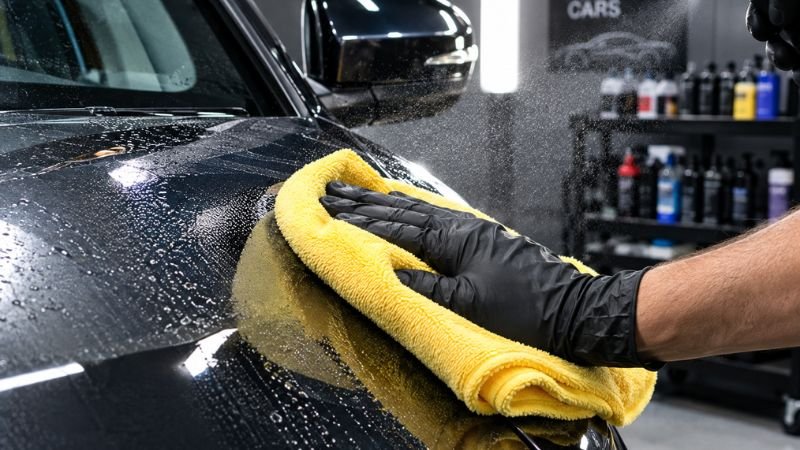
If you slide your clean fingertips across the paint and feel a rough texture, understanding how to remove water spots from car panels using a clay bar is your best option.
- Step 1: Clean the panel thoroughly.
- Step 2: Spray a generous amount of synthetic clay lubricant or rinseless wash onto a 2×2 ft section.
- Step 3: Take a clean piece of detailing clay and glide it back and forth using light pressure. Master how to remove water spots from car finishes by letting the clay pull the minerals out without pressing hard.
- Step 4: Wipe away residual lubricant with a clean microfiber cloth and check for smoothness.
Method 4: Commercial Chemical Water Spot Removers (For Stubborn Deposits)
When vinegar fails, specialized chemical removers offer the most direct answer for how to remove water spots from car clear coats without machine polishing.
- Step 1: Apply a few drops of dedicated water spot remover onto a foam applicator pad.
- Step 2: Work the product into the cool panel using overlapping circular motions over a small area.
- Step 3: Allow the chemical to dwell according to the manufacturer’s directions (usually 1 to 3 minutes max).
- Step 4: Rinse the panel thoroughly with water or wipe it down with a rinseless wash. Following safety steps is vital when applying chemical solutions for how to remove water spots from car paint.
Method 5: Machine Polishing & Compounding (For Etched Rings & Craters)
When minerals physically eat into the clear coat, mechanical leveling is the only way how to remove water spots from car panels completely.
- Step 1: Tape off sensitive plastic trim and rubber seals.
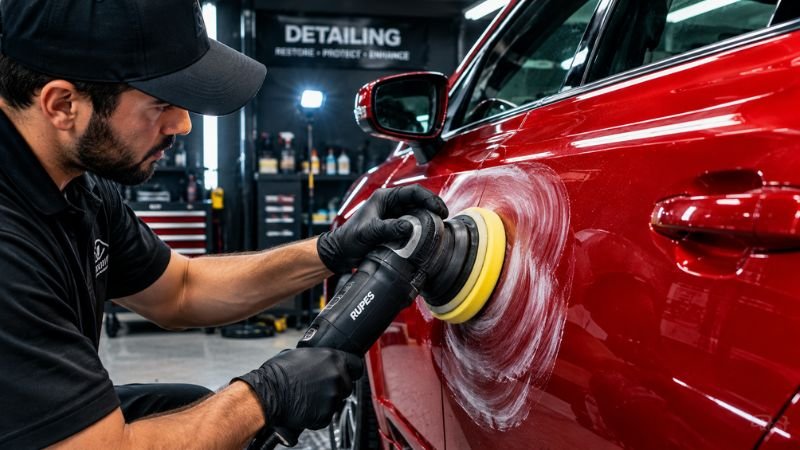
- Step 2: Attach a light cutting foam pad to a dual-action (DA) orbital polisher.
- Step 3: Apply 3–4 pea-sized drops of a fine finishing polish or All-In-One (AIO) compound to the pad.
- Step 4: Work the polisher on medium speed over a 2×2 ft section in cross-hatch passes using light downward pressure.
- Step 5: Wipe off polish residue with a clean microfiber towel. Master this technique on how to remove water spots from car clear coats to eliminate heavy etched rings safely.
How to Remove Stubborn Water Spots from Car Glass
Vehicle glass is much harder than clear coat, meaning mineral deposits bond tightly to windshields. If you are researching how to remove water spots from car glass specifically, standard methods might need a slight upgrade:
- 0000 Ultra-Fine Steel Wool Method: Spray a generous amount of automotive glass cleaner directly onto the glass and a pad of grade 0000 steel wool. Gently scrub the glass in circular motions. This provides a fast solution for how to remove water spots from car windows without scratching the glass.
- Critical Safety Warning: Never use steel wool on painted panels, tinted window film, or side mirrors.
Proactive Tips: How to Prevent Water Spots Entirely
Now that you know how to remove water spots from car surfaces, preventing them from coming back is the next step:
- Never Wash in Direct Sunlight: High temperatures cause water droplets to evaporate rapidly before you can dry the car.
- Apply Ceramic or Graphene Protection: Keeping a ceramic coating or graphene spray on your vehicle creates a super-hydrophobic barrier. You won’t have to worry about how to remove water spots from car panels as often if water slides off instantly.
- Avoid Lawn Sprinklers: Never park where sprinkler systems can spray your car, as well water contains heavy mineral counts.
- Dry Your Vehicle Immediately: Always use a dedicated drying towel or air blower after washing or rain.
Frequently Asked Questions
Will WD-40 remove water spots from car paint?
While WD-40 can loosen light surface oil deposits, it is not an effective solution when searching for how to remove water spots from car panels. It leaves an oily residue that attracts dirt and degrades paint protection.
Can baking soda remove water spots from a car?
Baking soda is highly alkaline and mildly abrasive. Using it as a paste on car paint can scratch sensitive clear coats. Vinegar or dedicated water spot removers are safer methods for how to remove water spots from car paint.
Does a car wash remove hard water spots?
A standard car wash only removes light Type 1 surface spots. If the minerals have baked into the clear coat, a basic car wash will not solve the issue of how to remove water spots from car finishes.